 View Account
Donald Trump and Political Cartoonists
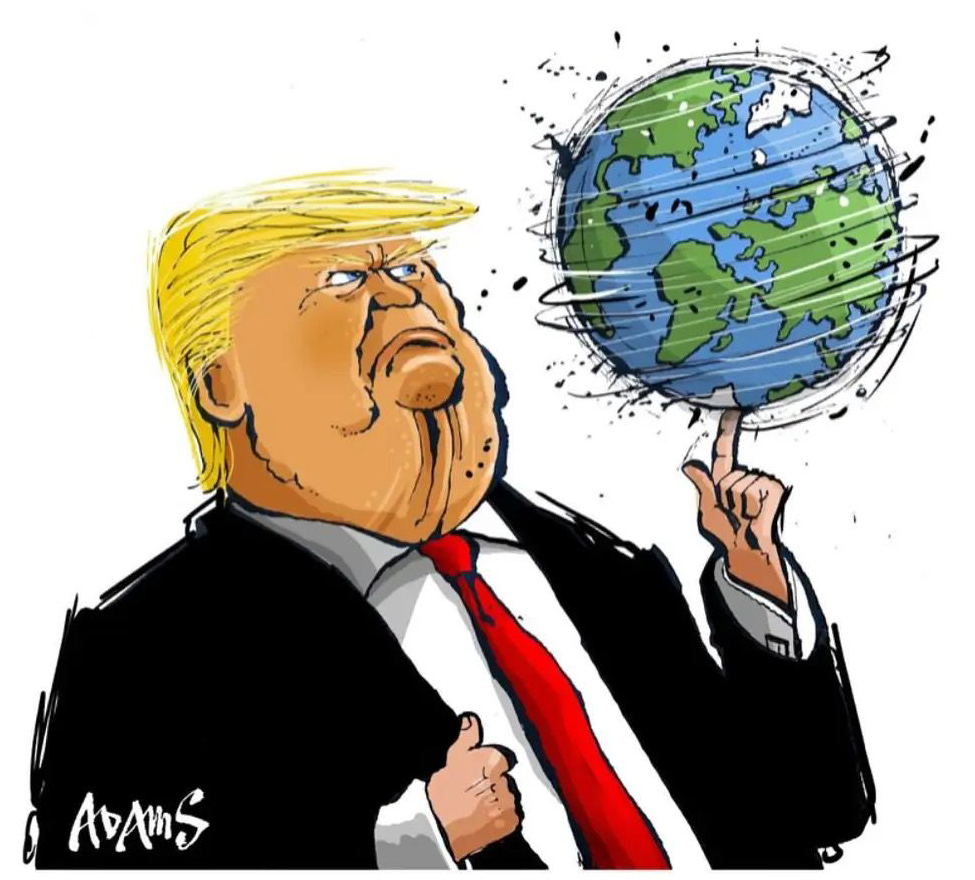 Whilst producing ‘Churchill: A life in Cartoons’ last year for Random House, I was somewhat startled to observe that there are a number of striking similarities between the man voted this country’s greatest Briton and the present American President Donald J. Trump. What? I can sense your disbelief and disgust, as I dare to even compare and contrast our greatest war-time leader with the draft-dodging orange blowhard now sitting in the White House. Surely the differences between the two men is vast? How can one even think to compare a man whose masterful and stirring oratory inspired Britain to victory in the Second World War to, say, Trump’s ability to spout gobbledygook for extended lengths of time without actually saying anything of substance at all!
Well firstly in defence of my supposition, I believe most people would accept that both men are polarising figures, despised and adored in equal measure. Secondly, the two of them attract enormous attention from cartoonists. Both are narcissists, extremely conscious of their own self-image. Before Trump, Churchill was the most cartooned politician in history. Apart from his exploits during the war, being in frontline politics for a record sixty years probably helped him in this regard. Since 2016, Trump, has dominated political cartooning around the world and especially in the United Kingdom. He has had the ability to constantly get the media to dance to his own tune. When President first time around, he appeared in a remarkable forty percent of the cartoons I selected, despite this anthology being primarily about British politics. Trump is able to dominate the news cycle with both his unstatemanlike hyperbole and bizarre behavior. As a consequence, he appears to have become invaluable to cartoonists. Morten Morland, for one, sees him as a godsend especially on slow news days: ‘When stories were thin on the ground, you could usually count on him to deliver.’ Whilst Nick Newman believes that even a Trump no-news day is news: ‘We should all starve him of the oxygen of publicity, but we simply can’t. We have to follow the news, and so long as the press follows him, we have to too.’ Steve Bright thinks he dominates the cartoon world ‘because he’s involved in everything we are involved in, Ukraine, tariffs even pinching half of Scotland before he became president.‘ There's a cartoon by Robert Leighton that appeared in the New Yorker in 2016, before Trump was even elected, which sums it up perfectly.’ (Add cartoon) Peter Brookes is of the same opinion, that he is impossible to ignore: ‘You can never give Trump too much attention. He'll tell you that himself.’ Consequently, Patrick Blower predicts that Trump will become the most ‘cartooned, satirized, mimicked, lampooned, and caricatured person that ever lived on this planet.’
Another similarity between Churchill and Trump is that they both lend themselves to caricature. They have what the late great David Low called ‘tags of identity’. These come in the form of either a distinctive dress style or accompaniments which clearly identify them from other politicians. This is done deliberately in order to publicly promote themselves so as to stand out from the crowd. For example, the cigar, the bow tie, the siren suit and V-sign all became recognisable symbols that personified Churchill. He developed these modes of identification over many years, having initially, as a young unknown politician, encouraged cartoonists to draw him by wearing many differing styles of hats that were too small for his head. Trump, on the other hand, arrived on the political scene with his persona already in place, such as the orange face tan, surreal blond hair, the ludicrous posture, overlong red tie and, during the 2016 primaries, his ‘little’ hands which became another valuable motif for all cartoonists as Morten Morland explains:
‘The tiny hands became a feature of mine and many other cartoonists’ drawings of Trump after Senator Marco Rubio said in a debate that Trump, who is 6ft 2in, has the hands of someone who is 5ft 2in - “and you know what they say about men with small hands.” It’s a curious one, because it was little more than a crude insult by one politician to another, so not something I’d usually adopt. As so often with Trump, though, it wasn’t the insult itself but his reaction to it which made it fly. He spent the rest of that election trying to convince the world that his hands are really very big. And that made it funny.’
As a consequence, Trump was instantly recognisable. Morland has found that ‘all politicians become characters in cartoons that develop over time as you get to know them. Trump arrived more fully formed than most, though. His bombastic personality, trademark hair and artificial colouring meant he became an instant favourite to draw… You can draw an egg with Trump’s hair and everyone instantly knows who it is. That gives you an incredible creative freedom. The hair becomes a character with a life of its own. The way I have painted the fake tan has changed quite a lot over the years. I didn’t immediately go full orange — initially it was just a slight tint, all over. As he appeared more and more bronzed in pictures, though, it was the invitation I needed to dip my brush straight in the orange bottle of ink and slap it on.’
As Morland has suggested, such tags of identity have become easy shorthand to cartoonists. Patrick Blower is of the opinion that you do not even have to be able to draw Trump in order to successfully caricature him, whom he sees as king of the props: ‘Start with the bulky body, put it in a blue suit with a red tie and stick a rudimentary orange face above and top it with a baseball cap with whatever the day’s slogan is - job done.’ Like other cartoonists, Steve Bright deems Trump the ‘gift that keeps on giving’ especially if you include his unpredictable and unstatesmanlike behavior in stark contrast to the political norm: ‘What we lacked in the UK is that kind of below the bar quality, we made up for in quantity with May, Johnson, Truss, Sunak and Starmer all in quick succession, but even when Trump's two terms were interrupted, he effortlessly managed to steal Joe Biden's thunder more often than not in the intervening years.’ Like Bright, Peter Brookes believes Trump’s tags of identity are only effective because of his shocking behavior: ‘Starmer’s hair stockiness is a great tag but is less impactful because he is perceived as boring.’ Somewhat facetiously, Nick Newman also agrees with Bright that Trump is a gift to cartoonists: ‘Outrageous, extreme, physically bizarre and grotesque . And such a nice guy with it! What more could a cartoonist want?’
Steve Bell disagrees, suggesting instead that Trump 'is not a gift, he’s a curse for the world in general of which cartoonists are a part.’ Despite finding him easy to draw, many are in sympathy with Bell in finding Trump’s behavior repulsive and his politics abhorrent. As Andy Davey confirms: ‘He may be larger than life and a buffoon, but he is a wannabe dictator, psychopath, megalomaniac, misogynist, liar and narcissist.’ Nicola Jennings concurs: ‘This year I have drawn Donald Trump more than anyone else. He is not a person I want to spend my time thinking about, or looking at - however nobody is beyond satire and he is sufficiently unpleasant to make a good caricature. I loathe him, but I approach drawing him with curiosity and the eye of analysis.’ Peter Schrank goes as far as say that Trump ‘is already a caricature or a character from a Looney Tunes cartoon. That hair, that skin colour, his appearance is quite grotesque.’ Peter Brookes, for one, took an instant dislike to Trump:
‘Whenever anybody wants to make allowances for Trump (like ‘Whatever you think of him, he has certainly delivered on such & such’ etc) I refer them to the moment in 2016, at an early campaign rally, when he gratuitously, in front of thousands, insulted a disabled reporter from New York by cruelly mimicking his contorted facial expression and manner of speech. I was horrified, and thought it unspeakably repellent and that he was totally unfit to be bidding to be the Leader of the Free World.’
After ten years of Trump, Brookes’s opinion of him has deteriorated. After Minnesota Congresswoman Ilhan Omar of Somali descent was attacked and sprayed with a substance (at the time nobody knew exactly what) while defending the motives of victims of ICE agents’ shootings. Trump commented on her ethnicity, as, according to Brookes, he has done repeatedly, and had remarked that she probably sprayed herself: ‘The man is a vile racist, and the worst western leader I’ve ever had to draw. Hate is a word I rarely, if ever, use as to how I feel towards a politician, but I very much do feel it towards him.’
With all this antipathy towards Trump, and knowing how easy he is to draw, one assumes cartoonists would, to use a footballing analogy, see him as something of an open goal. However, in practice, Trump’s bizarre demeanor makes him beyond parody and therefore visual attacks on him appear ineffective. Nick Newman says ‘it’s hard to caricature a caricature.’ According to Morland: ‘You almost can't ridicule him any more than he unwittingly manages to ridicule himself… Trump is often so ridiculous and outrageous that it makes it virtually impossible to exaggerate. So you might think you’ve produced a piece of outlandish mockery only to find that it’s a milder version of what took place. When facts are ignored, then skewering the president for lying is meaningless.’ Steve Bell concurs: ‘He’s too easy, you can’t satirise him… He is self-satirising, which renders him near-impossible to satirise effectively.’ Christian Adams is of the opinion that ‘despite being a gift for cartoonists, Trump also affirms the limits of what satire is. He says and does things that are more incredible than anything one could invent.’ Andy Davey agrees: ‘Well, he should be a gift. He is simply too outrageous to lampoon. He outflanks any attempts at satire. Satire is utterly pointless. He has no shame. And these circumstances are not normal. It’s like trying to satirise a warthog.’ Steve Bright believes ‘the truth is, more often than not, stranger than the satire. There's a cartoon by Robert Leighton that appeared in the New Yorker in 2016, before Trump was even elected, which sums it up perfectly.’ (Insert cartoon) Like the aforementioned cartoonists, Peter Schrank also thinks Trump is beyond the reach of satire: ‘He is too ridiculous, too outrageously offensive. To quote Tom Lehrer on Henry Kissinger winning the Nobel Peace Prize (and of course Trump craves that one too): satire is dead. One of the tools of satire is exaggeration. How can you exaggerate Trump? He wants Greenland, he wants Canada. It seems like a joke to show how deranged he is, but he’s serious.’ The other big issue for cartoonists is the realisation that although they tend to portray him as a hapless clown, the man with his finger in the nuclear button, can and is making the world a more dangerous place as Nick Newman suggests:
‘We may have just started drawing him as a joke, but quickly saw he was more dangerous than that. We all now turn to big hair, huge arse, tiny hands, red tie and orange complexion , but it doesn’t capture the inner egomania, vanity, megalomania, predatory creepiness and latent dementia that determine his every move. Many cartoonists now try to capture the fear and chaos he creates around him, as a way of caricaturing him. I should have added that as I find Trump tricky to get right, I try to do cartoons about him rather than featuring him.’
Peter Schrank is of the belief that ‘in an ideal world we should all ignore Trump. After all, what he really thrives on is attention.’ Trump supposedly does indeed crave the attention that cartoonists give him. Soon after being elected, he told Aaron Banks that he “loved political cartoons.’ This appears somewhat contradictory as Christian Adam explains: The basic thing is that Trump is incredibly thin skinned and hates being criticised and it’s our job to ridicule politicians as hard as we can. So it begs the question, does he actually look at our stuff or care?’ Although cartoonists dread including him in their work for the reasons already mentioned, they are obliged to do so. It is a conundrum, the more they draw him, the more he likes it as Bell has noticed: ‘He appears much too much, which tends to aggrandise him.’ Peter Brookes thinks ‘if you do not draw him, you are letting him off the hook. Cartoonists are duty bound to do so. His outrageousness becomes the norm. You have to draw him. Not to draw him is almost to concur with what he’s doing as all his utterances are appalling. He is his own satire.‘
A number of cartoonists have tried to find their own novel way of getting under Trump’s skin. Apart from depicting him as a bloated buffoon like everyone else, Steve Bell and Dave Brown have consciously focussed on creating a visual metaphor for his strange head of hair. Bell replaced his hair with a gold toilet seat and explains how this came about: ‘It was born of despair. On the morning waking up to the news that he’s actually come to power and I just despairingly did him as a toilet bowl. His hair is a kind of golden toilet seat, but it kind of works, there is something utterly disgusting about Trump.’ Bell has, in the past, been more successful than other cartoonists in creating visual metaphors that have got under the skin of senior political figures such as drawing George W. Bush as an ape, John Major wearing underpants over his trousers and David Cameron with a condom over his head. The problem with the toilet seat as a metaphor for Trump as I see it, is that the excrement should be flowing out and not in. Alternatively, Dave Brown has drawn Trump's hair as a separate entity from the rest of him and turned his hair into a rapid ferret attacking everything in its sights. Unfortunately, the problem Brown faces with that is a perspective issue, as Trump can only be drawn side on and not from the front as the ferret would not be wide enough to cover his whole scalp.
Has Trump as a caricature changed since he first appeared on the political scene in 2016? According to Steve Bright: ‘He's now ten years older than he was back then. His hair hasn't aged, but his face has, and he's put on a couple more shades of orange. The red tie gets longer and meanders more. Peter Brookes believes his self-satisfied smile is now much more dangerous: ‘He’s now shooting his own citizens so drawing him with a smirk is not the best way to do it.’ Christian Adams seems to be the only one to think that Trump’s hair has changed with age: ‘His hair is thinner now but other cartoonists still do him with a bouffant which only goes to compliment him. They are missing a trick as he recently complained that his hair looked thin on the front cover of Time Magazine.’ Surprisingly, Andy Davey has admitted to saying that he has always found Trump difficult to draw ‘which seems ridiculous given his character and all his little personal signifiers.’ Davey feels Morland has been the most successful in capturing Trump’s inner essence, with his depiction of this ‘massive porcine beast with orange face mask and dainty little trotters. He has, along with Steve Bell, also mastered his facial expression with a sort of baboon-like howling mouth.’ Contrary to everyone else, Steve Bell feels Trump has not changed one iota: ‘He’s still a shithouse/shithead!’
Do newspaper editors deter or encourage cartoonists to satirize Trump? It seems that newspapers on the left are happier than those on the right to allow their cartoonists to mock Trump. According to the Daily Telegraph’s Andy Davey: ‘My experience has been that the right-wing media secretly admires him but won’t come out and say it. So, usually when I submitted a Trump idea, it was ignored in favour of some idea about a minor infraction by Starmer.’ When at the Guardian, Steve Bell was free to attack Trump except for one occasion as Bell explains: ‘I was once censored for an overt nazi reference by a complete fuckwit, recently installed as “Opinion Editor.” One of Trump’s lackeys had actually described him as “the bodyguard of western civilisation”. I had a heated argument over the phone with the aforementioned fuckwit, but to no avail.’ Peter Schrank finds that at The Times, editors are generally quite happy to let him feature Trump: ‘They are not squeamish about how he’s portrayed. Sometimes an editor might feel that there have been too many Trump cartoons recently. I know that at The Economist they don’t like too many Trump cartoons in the paper. This is partially a design issue, but there might also be an element of not wanting to get on the wrong side of some US readers. This is an issue for the surviving US cartoonists.’ At the Daily Telegraph, Christian Adams finds that the editorial line changes from day to day on Trump because of his unpredictability: ‘For example, you don’t know what the editorial line is regarding the war with Iran, because one minute he praises the Prime Minister and the next day he chastises him so you don’t know what to draw.’ Patrick Blower, also at the Daily Telegraph, finds himself in the same predicament: ‘Trump is simultaneously a nightmare and a gift for cartoonists. He changes his spots so haphazardly, it’s impossible to know which Trump we’re lampooning. In the space of 24 hours he can declare an end to 'Forever Wars’, bomb a country, insult his allies, topple a foreign leader, order his allies to join him in battle, rename half the world, express satisfaction at the death of an adversary and still find time to play a round of golf.’
I have noticed that a cartoon on Trump receives far more attention on social media platforms than any that features say Keir Starmer, Nigel Farage or Kemi Badenoch. Patrick Blower has also noticed this: ‘It’s insane how much traction I get with cartoons about Trump and zero interest in UK domestic politics. If I do a great cartoon on the Government’s policy on Net Zero or the NHS, I’ll get one ‘like' on social media. An average cartoon of Trump can get me a million clicks and thousands of comments. Cartoonists need Trump. Even if he leads us into WW3, at least we’ll all die laughing.’ Nick Newman deems that this phenomena has a lot to do with his base of support in America: ‘He has more bonkers MAGA followers engaging in an argument with anyone who criticises him, so inevitably a Trump related tweet gets more traction.’ Steve Bright adds: ‘Whatever he says or does creates reaction from all sides. His Presidency is literally a TV action show with Trump as the headliner, but unlike his life before the White House, the weapons are real, not props with blank ammunition. He is what John Wayne always wanted to be.’ Peter Schrank says Trump gets so much attention on social media because he is the man most people in the UK love to hate: ‘Readers like to have their opinions and prejudices confirmed. And even people who are not interested in politics follow his antics. Perhaps that’s one good thing. He engages people who are not normally interested in current affairs.’
We have heard from cartoonists in Britain about the intricacies of depicting Trump, but how have those from around the world fared? In Australia, David Rowe, who draws for the Australian Financial Review, has received blowback for his work on Trump: ‘I got a lot of flak from America, a lot of hate mail and stuff like that. There's a lot of [Donald Trump] fans out there.’ Undeterred he still finds Trump one of his preferred people to draw: ‘Trump has just been a boon for cartoonists everywhere. It's just been incredible, every day. In fact, it's almost too easy, there's too much to keep up with, with Trump.’
In the United States, life is tough for those cartoonists who try and hold Trump to account. Many have come under pressure not to ridicule him, especially as he had threatened to go after those cartoonists who criticised him. During the last election, both the Washington Post and the Los Angeles Times even refused to publish cartoons endorsing Kamala Harris for president in fear of retribution by Trump. Kevin Kallaugher ‘Kal’ states that despite him being ‘compelling to draw with his strident hair, he finds Trump ‘a grumpy old grandfather, irritable, who looks miserable most of the time.’ Mike Luckovich of the Atlanta Journal-Constitution admits to being apprehensive when drawing Trump: ‘It’s a little nerve-racking… People always tell me I’ve got it made with Trump in office, and I tell them it’s like being married to a nymphomaniac. It’s fun at first, but then it becomes a nightmare. He’s a firehose of stupidity, lies and nonsense. It’s easier to cartoon people who are still somewhat competent and coherent because then you can raise the absurdity in your cartoon and reveal what’s going on. Whereas Trump is the guy at the end of the bar ranting nonsensically. So it’s hard to keep it fresh, especially after all these years.’ Luckovich does tend to infuriate MAGA supporters with his depictions of Trump: ‘I’m getting a lot more from people telling me my woke agenda has failed . I got one note from someone who called me a "dumb liberal shit." I have all these comebacks to that kind of nonsense, but I just don’t respond because who knows what these people are all about. It’s a cult, in my opinion, and I’m not going to upset cult members any more than I have to.’
Michael de Adder, Rob Rogers and Ann Telnaes, are three major cartoonists in North America who have already lost their jobs because of their depictions of the President. De Adder suffered the fate of having his contract terminated with Brunswick News after he shared a viral cartoon showing Trump playing golf next to the face-down bodies of two Salvadorian migrants. Rob Rogers was fired from the Pittsburgh Post-Gazette after twenty-five years because of his constant ridiculing of Trump. The paper had changed its editorial position and become supportive of Trump. Having told the editor that he was going to continue drawing him, the editor had replied 'Well it's not that I don't want you to draw Trump but they're just so negative and they're just so angry.' After the meeting Rogers stated that: ‘I felt they wanted were humorous cartoons that just poked light fun at Trump if I was going to do something on him. But they didn’t want anything that was too provocative or too scathing or too critical.’ After Rogers refused to conform to editorial guidance, he was fired, claiming that the changes at the paper were a symptom of a wider issue happening in newsrooms across the country, at a time when the sitting president had declared the media America's "biggest enemy." According to Rogers: ‘It's not about me. It's about where the paper's going, where the country's going and what journalism means in this country and whether it means a variety of opinions or just one opinion. By only representing one view that is favorable to the president, you're not keeping him accountable.’ Ann Telnaes resigned from the Washington Post after the paper refused to publish a cartoon of her proprietor at the paper, Jeff Bezos, kowtowing to Donald Trump. According to Ann Telnaes: ‘As an editorial cartoonist, my job is to hold powerful people and institutions accountable. For the first time, my editor prevented me from doing that critical job. So I have decided to leave the Post… I will not stop holding truth to power through my cartooning, because as they say, “Democracy dies in darkness”.’ I was surprised that Telnaes resigned over this as I do not believe it to be censorship. No cartoonist has the right to be published and no one, literally no one, ever got away with mocking their own proprietor unless it was, of course, with their specific consent.
Patrick Chappatte of the New York Times was another cartoonist who had decided to quit, because in his mind Trump had killed satire stone dead. He came to this conclusion after attending the inauguration of Trump’s ‘Board of Peace.’ According to Chappatte: ‘ I don’t know whether I witnessed a farce or something completely unreal. I have never seen anything like it. They are in the process of making me unemployed…
Trump stands at the center. The show in Davos was a kind of submission to Trump. Heads of government and state had to sit on stage in a humiliating posture before the audience and listen to Trump congratulate himself. And then we are shown PowerPoint slides about Gaza with AI-generated images of high-rise buildings. It is no longer about history, no longer about international law or international institutions. It is simply a real-estate deal. Trump didn’t even try to hide that and explicitly said that everything begins with real estate. Even peace. He is very transparent, unfiltered. That reminded me of one of my cartoons: I depicted him standing in front of the ruins of Gaza saying, “Great real-estate development potential!” That was in January 2025, before Trump was even in office. One year later, it is official US policy to turn Gaza into a major real-estate project. Reality has completely overtaken the cartoon. You no longer know what to do - laugh or cry, or both at the same time.’